


Someone Else's Poem: A Memoir Essay on Internalizing Our Parents

Each of us lives a life, each life a kind of poem.
Some are sonnets, orderly and disciplined. Some are jazz improvisations. Some seem to abandon melody, harmony, and rhythm altogether.
As children, we inherit our first poetry from our parents. Or one particular parent. Sometimes we internalize their example; sometimes we react against it. Sometimes we simply supply what is necessary to fill in the gaps.
In the first four years of my life, I had a loving mother and a distant father. An overwhelmed mother and an alcoholic father. A traumatized mother and a mean father. From that mother, I learned affection for my own children. From that father, I learned to fear and avoid anger, both in others and in myself.
In the next couple of years, my mother was my only parent, and she was seriously floundering as a single mom of six, rapidly deteriorating, spiraling towards disintegration. I saw her distress and worried for her. At the same time, somebody probably should have been worried about me.
At the mercy of her mental illness, that experiment in independence ended badly. Very badly. Her suicide attempt was extreme.
It took months for them to patch together her brutalized body.
Then came the electricity.
Enough volts to erase a year of memories and bring her home smiling vaguely.
There’s a gruesome fairy tale in which a father, tricked by the devil, chops off his daughter’s hands with an ax.
That image of the handless maiden has become, for me, a symbol of my mother: increasingly helpless, increasingly withdrawn from adulthood, until she ended her life when I was sixteen.
She had just enough agency left for that.
But rewind to my prime childhood years of six to thirteen, when my functional parent was my grandmother. She was not the plump, kindly Grandma most people think of. She was made – by far – of sterner stuff. Non-affectionate. Perfectionistic. Domineering. Determined. And silently but visibly pissed off at having to raise all those grandchildren.
In the poem of my life, Grandmother became my dominant motif. Starved for structure and surety, I eagerly swallowed what she was selling. I thought that, if I worked hard enough, if I was good enough, if I was absolutely perfect, I could win her love. Or maybe at least her approval.
My mother’s poem was surrender.
My grandmother’s poem was competence.
And somewhere along the way in my own life, I mistook achievement for salvation. No mercy for myself. No rest. Just push, push, push.
I drove myself, eventually, right off the cliff.
The good thing about collapse is that it forces you to reckon with which burdens are essential and which are merely inherited.
It wasn’t until I was lying at the bottom, broken and unable to rise, that my poem began to slowly change. I gave up trying to be perfect. I gave myself permission to be distracted by beauty. I gave myself over to small pleasures. I returned to playtime. Twirling till I fell down, giggling, the world spinning pleasantly inside my skull.
For a long time, I lived inside poems written by other people.
My mother’s melody that faded before the resolving chord.
My grandmother’s march of relentless productivity.
These days I am writing my own poem.
I’d like it to have a riot of color. Some silliness. Lots of mercy. A little music. Perhaps a harmonica tune drifting through the night from a campfire.
Not perfect.
Just mine.
October 2026
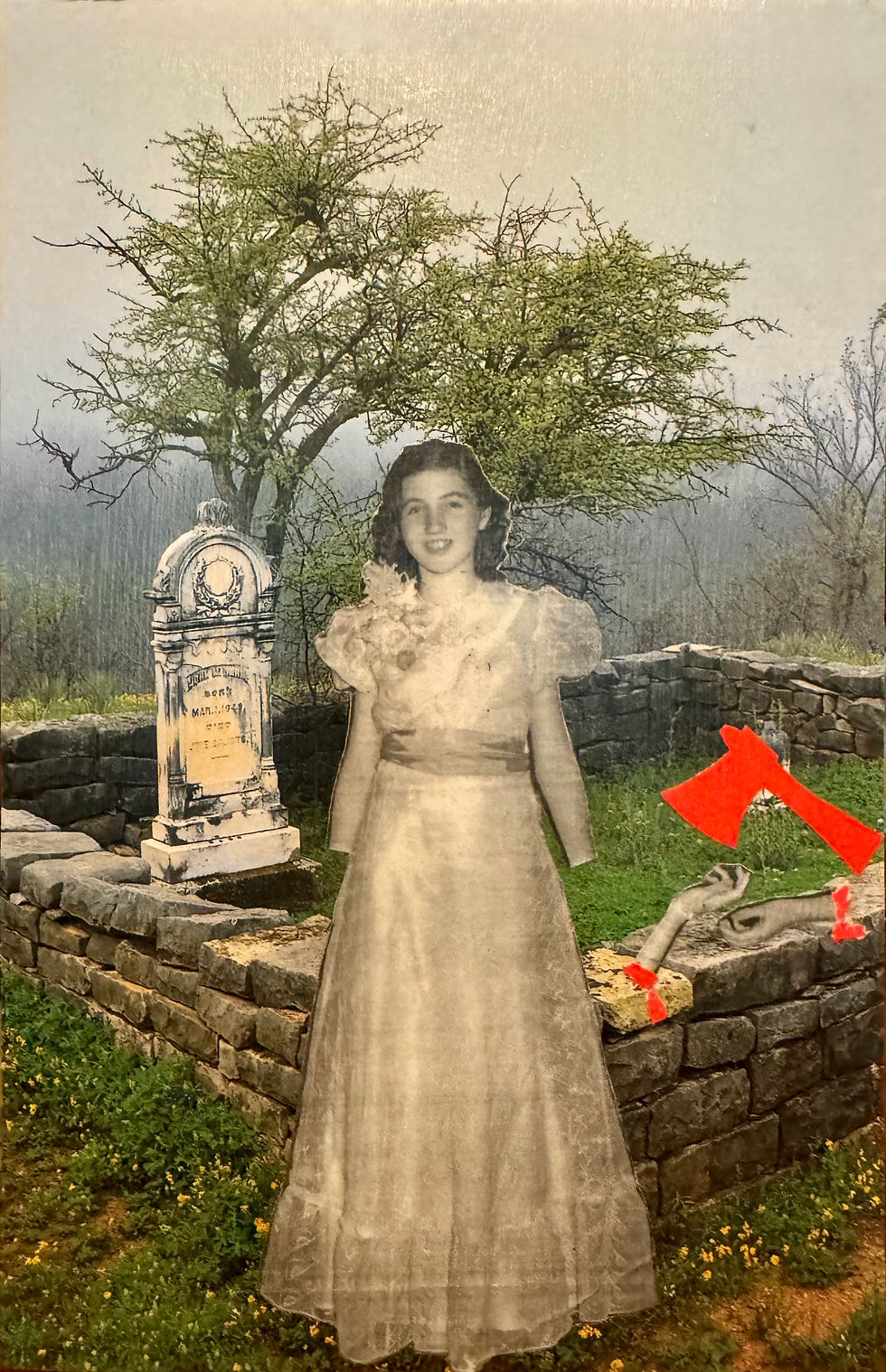
P.S.: In fairness to the story of "The Handless Maiden," after her father's brutal betrayal, the maiden shows remarkable courage. She leaves the home where she is promised a life of luxury and safety and ventures, alone and handless, into the dark forest, where she encounters both provision and further challenges. In the end, she grows her own hands back. Kudos to her.
It is only that single, title snapshot from the tale that reminds me of my mother. On the one hand, she sometimes expressed great frustration with her limitations. But often her retreat from the demands of adulthood seemed to arrive like gifts wrapped in a kind of cheerful relief.
Lately, as I've been sitting with this image, I feel such deep sadness for her. I have no doubt that she was doing the best she could. Though I could not hear what chaos and voices swirled around inside her head, I witnessed her anguish. And there is a realization that I was not just a witness to her suffering, but that who I was and who I am becoming is shaped by her pain as a blown glass goblet is shaped by the fire.
And I can hold in one hand the truth of pain and in the other, I can hold love, healing and growth, knowing that the human heart is full of such contradictions. And isn’t that what makes us so marvelous, we beautiful handless maidens?


I can see the hand of God in the overcoming and beauty in a life well lived. Thank you for sharing. ♥️
So tragically beautiful (and expressed!): “…who I was and who I am becoming is shaped by her pain as a blown glass goblet is shaped by the fire.”🙏❤️
Beautifully written. I’m so sorry your mom suffered serious mental illness, and I feel for your childhood, for little girl you. What a remarkable woman you are, so much personal growth, resilience, compassion.
Your essay took my breath away with its truth and beauty, darkness and resolve. Thank you, Celeste! You never fail to amaze.